

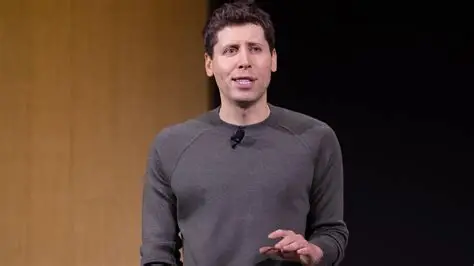
At a time when artificial intelligence is expanding at an unprecedented pace and reshaping industries from healthcare to finance OpenAI Chief Executive Officer Sam Altman stepped onto a stage in India to confront one of the most persistent criticisms facing the technology sector today the environmental cost of AI systems Speaking at an event hosted by The Indian Express during his visit to the country for a major artificial intelligence summit Altman delivered a forceful rebuttal to claims circulating online about the water and energy footprint of systems such as ChatGPT while also acknowledging that the broader growth of AI inevitably raises important questions about global power consumption
Altman’s remarks come amid a growing global debate about the sustainability of large scale data centers and high performance computing infrastructure that underpin generative AI models In recent months social media posts opinion columns and academic discussions have increasingly focused on the environmental implications of training and operating massive neural networks Critics have pointed to figures suggesting that a single AI query may consume significant amounts of electricity and water often comparing it to everyday household usage in an effort to make the numbers relatable to the public
Addressing these concerns head on Altman dismissed widely shared claims about water usage as exaggerated and disconnected from present day operational practices He described assertions that using ChatGPT consumes the equivalent of seventeen gallons of water per query as entirely untrue and divorced from reality According to Altman such figures reflect outdated assumptions about how data centers are cooled and do not account for the technological shifts that have taken place in recent years

In earlier generations of data center design evaporative cooling systems were more common and these systems did indeed rely on significant volumes of water to regulate temperatures in facilities packed with heat generating servers Altman acknowledged that water use had once been a legitimate issue when evaporative cooling was widespread However he emphasized that many modern facilities no longer rely on those same methods Instead operators have adopted alternative cooling technologies including advanced air cooling liquid cooling and hybrid approaches that are designed to improve efficiency and reduce environmental strain
By framing the water usage debate as a misunderstanding rooted in outdated infrastructure Altman sought to reassure audiences that the environmental cost of interacting with AI models is being mischaracterized in public discourse He argued that viral claims warning people not to use ChatGPT because of supposed extreme water consumption are misleading and risk distorting a more nuanced conversation about sustainability
While rejecting what he sees as inflated water usage figures Altman took a more measured tone regarding energy consumption He conceded that it is fair to raise concerns about the total energy demands associated with the rapid global adoption of artificial intelligence His distinction was clear the issue is not the marginal cost of a single query but the aggregate demand created by millions or even billions of interactions taking place every day across the world
The surge in AI adoption has coincided with a dramatic expansion of data center construction Cloud providers and technology companies are racing to build facilities capable of supporting increasingly complex models and the computational requirements needed to train and run them The scale of these operations is vast with clusters of specialized processors consuming substantial amounts of electricity As AI tools become embedded in search engines office software design platforms and customer service systems the baseline demand for computing power continues to climb
Altman argued that the appropriate response to rising AI energy consumption is not to halt innovation but to accelerate the global transition toward cleaner energy sources In his view the solution lies in moving rapidly toward nuclear power wind energy and solar power He suggested that the expansion of AI could serve as a catalyst for investment in sustainable infrastructure rather than as a reason to curtail technological progress

This position reflects a broader trend within the technology sector where leading executives increasingly frame AI as both a challenge and an opportunity for climate strategy On one hand large scale computation undeniably consumes electricity On the other hand AI systems are being deployed to optimize power grids improve energy efficiency in buildings model climate patterns and accelerate scientific research in clean technologies The net environmental impact of AI may therefore depend on how societies choose to power and deploy these systems
One of the complicating factors in the public debate is the lack of standardized reporting requirements for energy and water usage by technology companies There is currently no universal legal mandate requiring firms to disclose detailed breakdowns of resource consumption tied specifically to AI workloads As a result researchers and environmental scientists have had to estimate usage through indirect methods including analyzing hardware specifications modeling computational requirements and examining regional power data
These independent studies have sometimes produced headline grabbing statistics that are easily shared but difficult for the average reader to contextualize Without transparent and consistent disclosure frameworks it becomes challenging to verify competing claims or compare the efficiency of different systems across companies and geographies This gap in reporting has contributed to an environment in which both alarmist and dismissive narratives can circulate without clear empirical grounding
The conversation in India also touched on another widely cited comparison involving electricity usage An interviewer referenced a previous discussion with Bill Gates and asked Altman whether it was accurate to say that a single ChatGPT query uses the equivalent of one and a half iPhone battery charges Altman responded unequivocally that there is no way the energy consumption is anywhere close to that level
By challenging such analogies Altman underscored his broader concern that the environmental debate around AI often relies on simplified comparisons that fail to capture the complexity of how these systems operate A smartphone battery charge is a tangible metric for consumers but equating it directly to an AI query can obscure important variables including server efficiency hardware utilization data center optimization and the distinction between training and inference phases
Training a large language model requires immense computational resources and can involve weeks or months of continuous processing across thousands of specialized chips This phase is energy intensive and has rightly attracted scrutiny However once a model is trained the energy required to generate a single response known as inference is typically far lower on a per query basis Altman argued that critics sometimes conflate these stages or focus disproportionately on the training phase when discussing everyday usage
He further suggested that some comparisons are conceptually flawed particularly when they contrast the energy required to train an AI model with the energy cost of a human performing a single cognitive task In his view such framing ignores the substantial biological and societal investment required to produce human intelligence Altman offered a provocative analogy noting that it takes roughly two decades of life sustained by food education and social infrastructure to train a human mind capable of complex reasoning He extended the argument even further by invoking the cumulative evolutionary process involving billions of people over millennia that has shaped modern human cognition
While this comparison may strike some observers as philosophical rather than strictly scientific it highlights an important question about how society evaluates efficiency Should the benchmark for AI be the immediate power draw of a server or should it account for the broader lifecycle costs of alternative systems including human labor If measured purely in terms of energy expended to answer a specific question after a model is already trained Altman suggested that AI may already be competitive with or even more efficient than human counterparts
The implications of this claim are significant As AI systems are integrated into education customer service legal research software development and creative industries the relative efficiency of machine intelligence versus human effort becomes a central consideration If AI can perform certain tasks with lower marginal energy input than human labor it may alter not only economic calculations but also environmental ones
However critics might counter that the analogy oversimplifies the comparison between biological and artificial systems Human cognition is not powered by fossil fuel generated electricity in the same way data centers often are and the environmental footprint of human activity is distributed across complex social and ecological networks Moreover questions about AI efficiency must also account for rebound effects where lower marginal costs lead to higher overall usage potentially increasing total energy demand
Altman’s remarks in India reflect a balancing act that technology leaders increasingly face They must defend their companies against claims they view as inaccurate while also acknowledging legitimate concerns about scale transparency and sustainability As AI continues to permeate daily life the public will demand clearer answers about its environmental footprint
The backdrop to this debate includes reports linking data center expansion to rising electricity prices in certain regions Large facilities can place significant strain on local grids especially in areas where renewable capacity is limited or transmission infrastructure is outdated Policymakers therefore face the challenge of accommodating economic growth driven by digital infrastructure while ensuring that communities are not burdened with higher costs or environmental degradation
In emerging markets such as India the stakes are particularly high The country is investing heavily in digital transformation and artificial intelligence as part of its broader economic development strategy At the same time it grapples with energy access challenges air quality concerns and climate vulnerability Altman’s call for rapid deployment of nuclear wind and solar power aligns with India’s stated ambitions to expand its renewable energy capacity yet translating that vision into reality will require coordinated action across governments industry and civil society
Ultimately the discussion at The Indian Express event illustrates how the narrative around AI is evolving The early years of generative AI were dominated by conversations about creativity productivity and disruption Today the discourse increasingly encompasses governance ethics and sustainability Environmental impact has joined bias misinformation and job displacement as a central pillar of public scrutiny
For companies like OpenAI maintaining public trust will depend not only on technical innovation but also on transparency and engagement Providing clearer data on resource usage investing in efficiency improvements and supporting clean energy transitions may become as important to long term success as breakthroughs in model performance
Altman’s emphatic dismissal of certain viral claims suggests that he believes the conversation has at times drifted into hyperbole Yet his acknowledgment that total energy consumption is a fair concern indicates recognition that scale matters As billions of people interact with AI systems the cumulative footprint cannot be ignored
The path forward may involve a combination of improved measurement standards regulatory frameworks and market incentives encouraging greener infrastructure Governments could consider requiring more detailed disclosure of data center resource use while industry groups might collaborate on best practices for efficiency and sustainability Meanwhile advances in chip design algorithm optimization and cooling technologies could further reduce the energy intensity of AI workloads
As the interview concluded viewers were reminded that the debate over AI’s environmental impact is far from settled It is a dynamic conversation shaped by technological progress policy decisions market forces and public perception What remains clear is that artificial intelligence is becoming an integral part of the global economy and its resource demands will continue to attract scrutiny
In defending his company’s technology Altman positioned AI not as an environmental villain but as a tool whose impact depends on how humanity chooses to power and deploy it Whether the world heeds his call to accelerate investment in nuclear wind and solar energy may determine whether the growth of AI becomes a burden on the planet or a driver of a more sustainable digital future